
The Kind of Tired That Sleep Doesn't Fix
Story at a glance
“Maya has been promoted twice in three years and never misses a deadline. One Monday in March she sits down on the bathroom floor and can't get up. The story follows what she does next.”
Share this story
On a Monday morning in March, Maya Chen woke at 5:47, before her alarm. She lay still and looked at the ceiling. The mortgage was paid. Her seven-year-old daughter Lily was healthy. Her performance reviews were excellent and her manager trusted her. Nothing was wrong, and that made it harder to explain why getting up felt impossible.
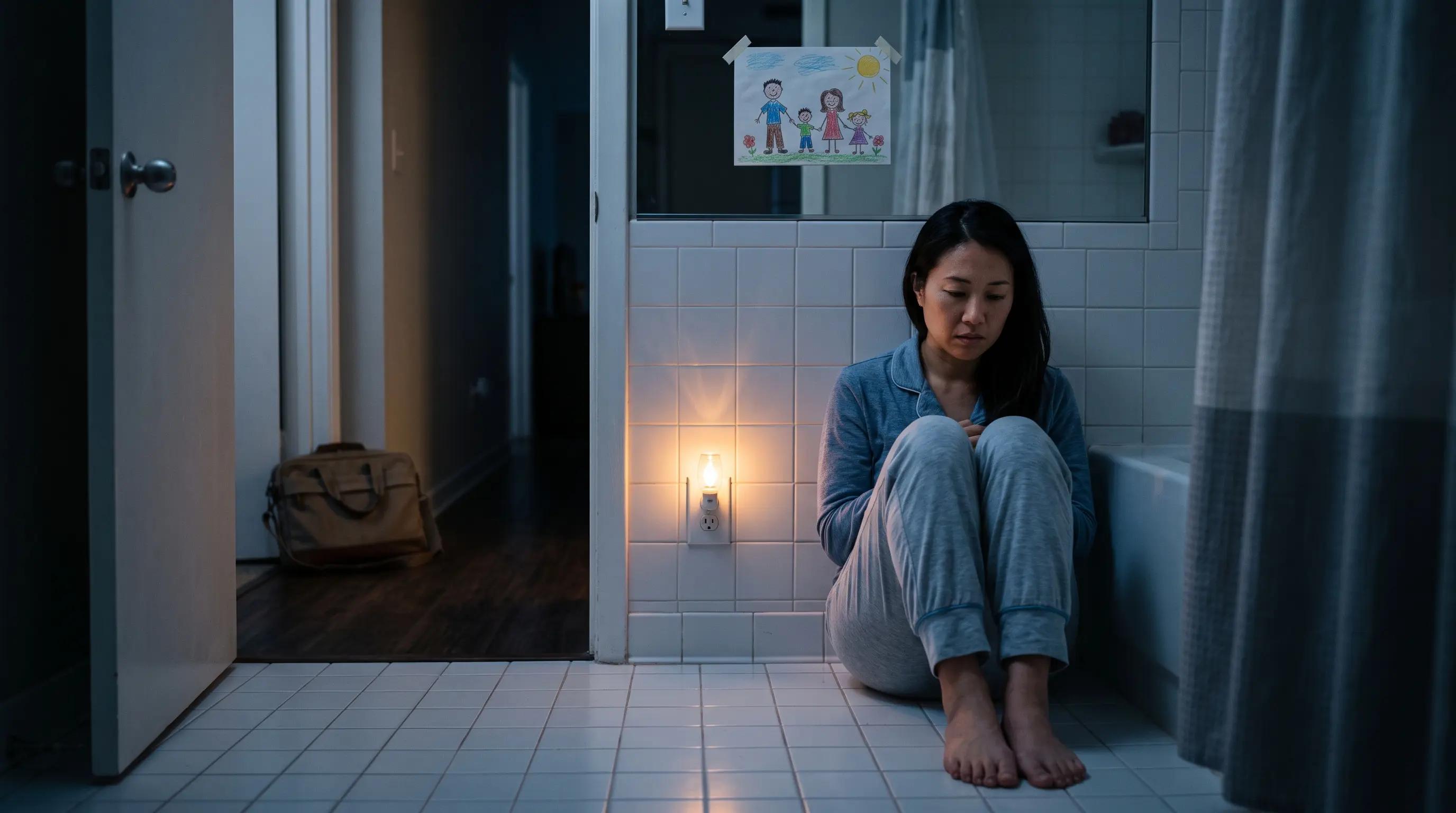
She made it as far as the bathroom. Then she sat down on the cool tile floor with her back against the wall and her knees pulled up, and stayed there. She wasn't crying or panicking. It was something quieter than either, a tiredness that pressed from the inside, the kind that sleep doesn't touch. She had been ignoring it for months, and that morning it had decided to sit with her until she paid attention.
She was thirty-four, a senior product manager at a healthcare software company in Austin. She had been promoted twice in three years. Her manager said she made the impossible feel manageable. Outside work she was raising Lily mostly alone since her marriage ended three years earlier. She cooked, went to every school event and sang the same song at bedtime. Then she went back to her desk. When people asked how she did it, she said, "You just figure it out."
What she hadn't noticed was the cost. Books she used to finish in days sat unopened on her bedside table for weeks. She canceled dinners with friends. Some evenings, after putting Lily to bed, she sat in the dark kitchen for twenty minutes without knowing why. Work had become something she went through, not something she cared about. Her results never slipped, but she was running on momentum, the habit of being capable, and momentum runs out without warning.
After about forty minutes on the floor she heard Lily's door open down the hall. Small footsteps, a pause. "Mommy?" Maya stood, splashed her face and said, "I'm here, sweetheart, just getting ready." She dropped Lily at school with a hug that lasted a little longer than usual, sat in the parking garage for eleven minutes, and then led a nine o'clock meeting as though nothing had happened. Nobody noticed. That frightened her more than the floor had.
Three weeks later, in a one-on-one, her colleague Priya put down her coffee and said, "Can I ask you something personal? Are you okay? Not work-okay. Actually okay." Priya was the calmest person Maya knew. Maya opened her mouth and the automatic answer was already there, but it didn't come out. "I don't know," she said. Priya nodded. "I cried in my car every Tuesday for three months last year," she said. "I told no one. I kept delivering and I thought I was the only one." She looked straight at Maya. "You're not."
That night, after Lily was asleep, Maya opened a notebook at the kitchen table and wrote across the top of a page: What am I actually feeling? She hadn't asked herself that in years. The answers came quickly. She was exhausted. She was lonely. She was angry at herself for not being able to push through, sad for no reason she could name, and scared that this was what her life was now. When she finished, she saw that she hadn't described a woman who had everything together. She had described a woman who needed help.
The next morning she made two phone calls, one to her doctor and one to a therapist her sister had mentioned months earlier. Neither was easy. Both felt like admissions she wasn't ready to make. The therapist, Dr. Angela Torres, was warm and direct. In the first session she asked, "When you say you need to be strong, what would happen if you weren't?" Maya had no answer. "Who would be disappointed?" Maya started listing names and stopped, because the first on the list was her own.
Dr. Torres gave her one piece of homework: do one thing this week that has no purpose except that it makes you feel like yourself. Maya spent three days not understanding the assignment. On Saturday, with Lily at her father's, she drove to a hiking trail outside Austin that she had passed a hundred times without stopping. It wasn't spectacular, just cedar and limestone. She walked for ninety minutes with no music and no phone. About forty minutes in her head went quiet, not blank, only quiet. She stood beside a small creek and listened to the water, and realized she could not remember the last time she had listened to anything without thinking about something else.
Recovery was slow and mostly unremarkable. The hardest part was not the therapy. It was letting herself rest without turning the rest into a reward. She started protecting her lunch hour a few days a week. She left the office at a reasonable time two or three days a week, and the projects didn't collapse. She started cooking on Sundays again, not elaborate meals, just chopping and music and being in her own kitchen without a screen. One Friday she put Lily to bed and sat in the dark kitchen as she used to, but this time she let herself sit there, and then she made tea and read twelve pages of a book.
Two months after the bathroom floor, her manager asked how she was doing outside the numbers. A year earlier Maya would have said fine without pausing. This time she told a small piece of the truth: she had been dealing with burnout and some of her boundaries needed to change. Her manager was quiet. "Thank you for telling me," she said. Then, more quietly, "I've been there too." Nobody mentioned her performance. Maya drove home wondering how many conversations like that weren't happening in offices everywhere.
A year after the bathroom floor, Maya met Priya for coffee. "You seem lighter," Priya said. Maya thought about it. "I stopped trying to convince everyone I was fine," she said. She had learned something simple: being capable and being all right are different, and she had spent years treating them as the same thing.
Every story matters
Stories like this one remind us that no matter how difficult life gets, there is always a way through. If this story moved you, share it — you never know who needs to read it today.
Share this story
More in Mental Health & Burnout
You might also like

Nineteen Days
After his startup shuts down, a developer in Dublin counts the days. Most of them are small: a plate, a walk, a coffee, a line of code.

The Designer by the Window
Imran talks to everyone at his Colombo agency except the quiet designer by the window, who has never answered him. A promotion, a pitch and a paper cup of tea change that, a little.