
Measuring for Aprons
Story at a glance
“The school fees have gone up forty per cent. On a rainy Wednesday in Kandy, a tailor notices the café being built across the road and what its staff will need to wear.”
Share this story
The letter from Hiruni's school had been on the shelf above the sewing machine for nine days, propped against a tin of buttons. Sampath had read it so many times he could have recited it. The new term's fees were up by almost forty per cent, to cover the science block and a new laboratory, and the balance for the old term was still owing.
It was Wednesday. It had rained since six, the kind of Kandy rain that arrives sideways, and at eleven he was still alone in the shop with a pair of school trousers in his lap and a thread caught between his teeth.
His father's machine was a black Singer with gold lettering rubbed down to ghosts. His father had bought it second hand in 1974 and Sampath had learned to thread it standing on a box. It still ran better than the newer one he'd bought on a loan. The shop itself was a room attached to the front of the house, with a counter, a mirror, a tape measure nailed along the edge of the table and a leak in the corner that he caught in a biscuit tin.
Mrs Fernando came in at half past eleven to collect her son's uniform, dripping on the floor. He pressed it for her and folded it in brown paper. She paid, and then she stood in the doorway looking across the road.
"They're opening a café over there," she said. "Finally. That place has been scaffolding for months."
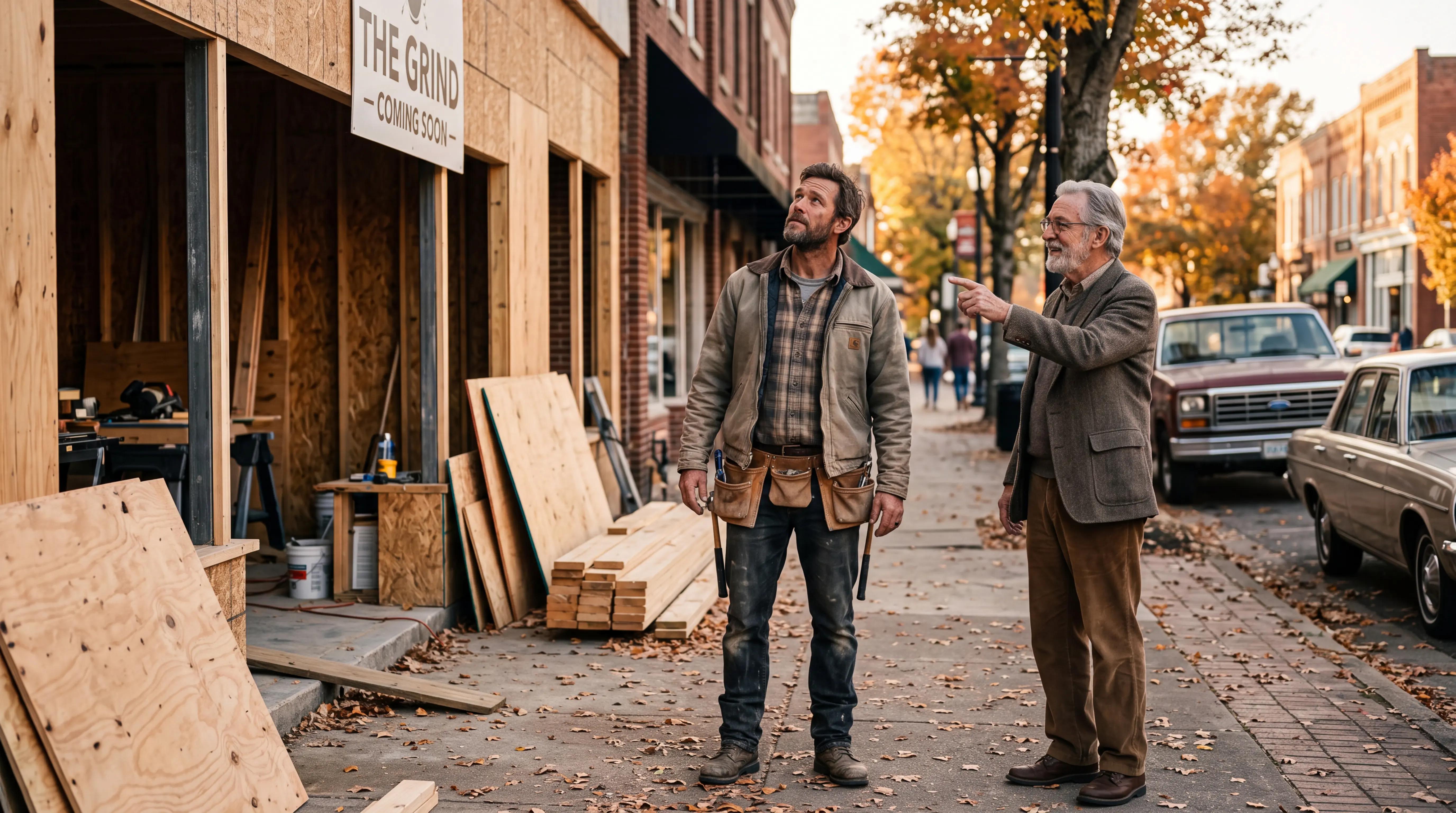
He looked. He'd seen it, naturally. Everyone on the street had. Men with buckets had been in and out since the monsoon began; the sign had gone up the previous week, painted green, something with a teapot on it. Through the open front he could see a long counter half covered in plastic sheeting, benches against one wall and a stack of chairs still in their wrapping.
"They'll be busy," Mrs Fernando said, and went off under her umbrella.
Sampath went back to the trousers.
He'd been thinking about money for fifteen years, in the sense that money had been thinking about him. Every month he did the same arithmetic on the back of an envelope: rent, rice, the scooter, Hiruni's fees. Every month the total was a few thousand rupees past what he'd earned. He worked longer days, took more alterations, and said yes to every wedding blouse anybody asked for. His customers loved him. Several had told him so in the same breath as haggling the price down.
He sewed for another twenty minutes. Then a thought arrived that had nothing to do with him. A man in that café would need someone behind the counter, and that someone would need an apron.
He stopped the machine.
Aprons. Staff shirts. Curtains for the big window, and cushion covers for the benches, which looked bare. Napkins, probably. A café of that size would have six or eight staff, and the owner would want them to look as though they belonged to the same place. He felt faintly foolish. He'd walked past that building twice a day for months and seen scaffolding.
He looked at the letter on the shelf. He looked at the café.
It was nearly one when the rain eased. He changed his shirt, which took a minute and a half, because he owned two. He took the tape measure from its nail, the little notebook from the drawer and a half-metre of green cotton from the roll he'd been saving for a cushion. He put them in a plastic bag. He locked the shop and ran across the road with the bag over his head.
Inside, the smell was fresh plaster and paint. A woman in her fifties was standing on a stool with her back to him, pinning up a paper sign, and a young man was drilling a shelf into the wall. She turned. "We're not open until the fifteenth," she said, not unkindly.
"I'm the tailor from across the road," said Sampath. He had rehearsed this sentence on the way over and it still came out wrong. "I make aprons."
She got down from the stool. She had a pencil behind her ear and reading glasses pushed up into her hair. She said her name was Mrs Ranatunga, and that she'd been told a hundred times to order uniforms from a company in Colombo, and that she hadn't, because the samples had arrived with the logo printed upside down.
"Who's sewing for you now?" Sampath asked.
"Nobody. That's the problem." She laughed. "I have eight staff arriving in two weeks wearing their own clothes."
He took the green cotton out of the bag. It was a decent weight, he said, and would wash well. He folded it into a loose apron shape with his hands and showed her where the pocket would go, and how he would cut the strap so it didn't dig in. He said he could make one by Monday, free, so she could see it. He felt his ears go hot. He had never offered anything for free in his life.
Mrs Ranatunga held the cloth up to the window and squinted at the weave. She turned it over. She asked what the stitching would be like on the corners, and he said double, and she asked how much he'd charge for eight, and he named a figure. It was lower than it should have been. He knew that as he said it.
"Bring me the one," she said. "Monday. We'll see."
He measured the young man at the drill, who stood with his arms out like a scarecrow, laughing. The numbers went into the notebook: chest, waist, length, shoulder. Sampath wrote them very neatly.
Hiruni came in at half past three in her school uniform, the hem he had let down in January, and dropped her bag on the stool. "Thaththa, I got ninety-one in the science test."
He said that was very good. She told him the teacher had asked what everyone wanted to be, and four girls had said doctor, and a boy had said astronaut and been laughed at. "What did you say?" he asked. She gave him the look she gives when the answer is obvious. "Doctor," she said. "You'll help me, won't you?"
He said of course he would, and she went through to the house for her tea. He sat with the green cotton on his knee for a while after that.
The shop stayed shut for the rest of the afternoon. The rain had started again. The letter was still on the shelf against the tin of buttons, saying what it had said before.
He put the green cotton on the cutting table. He picked up the chalk. He didn't know whether Monday would bring a contract or a polite no, or what the figure at the bottom of the letter would be next month. What he knew was how to cut an apron. He drew the first line along the fold.
The café had stood across the road for months and he had walked past it twice a day. The chance had never been hidden. He had only needed to look at his own street the way a tailor looks at it, and ask who would need something made.
Every story matters
Stories like this one remind us that no matter how difficult life gets, there is always a way through. If this story moved you, share it — you never know who needs to read it today.
Share this story
More in Work & Career
You might also like

The Project He Forgot
Arjun leaves a good job to chase what everyone on his feed seems to have, and spends months collecting rejections. The answer turns out to be a project he built three years earlier and forgot.
What Would You Actually Miss?
Margo, an inventory clerk with a serious illness, keeps a private list called What Will I Miss. She asks a colleague who has stopped noticing his own life the question she has been asking herself.